Pipelines in architectural patterns
Several architectural patterns involve a unidirectional data flow – a pipeline. Strictly speaking, every data packet in a pipeline should:
- Move through the system over the same route with no loops.
- Be of the same type, as a part of a data stream.
- Retain its identity on the way.
- Retain temporal order – the sequence of packets remains the same over the entire pipeline.
Staying true to all of these points makes Pipes and Filters – one of the oldest known architectures. Yet there are other architectures that discard one or more of those conditions:
Pipes and Filters#
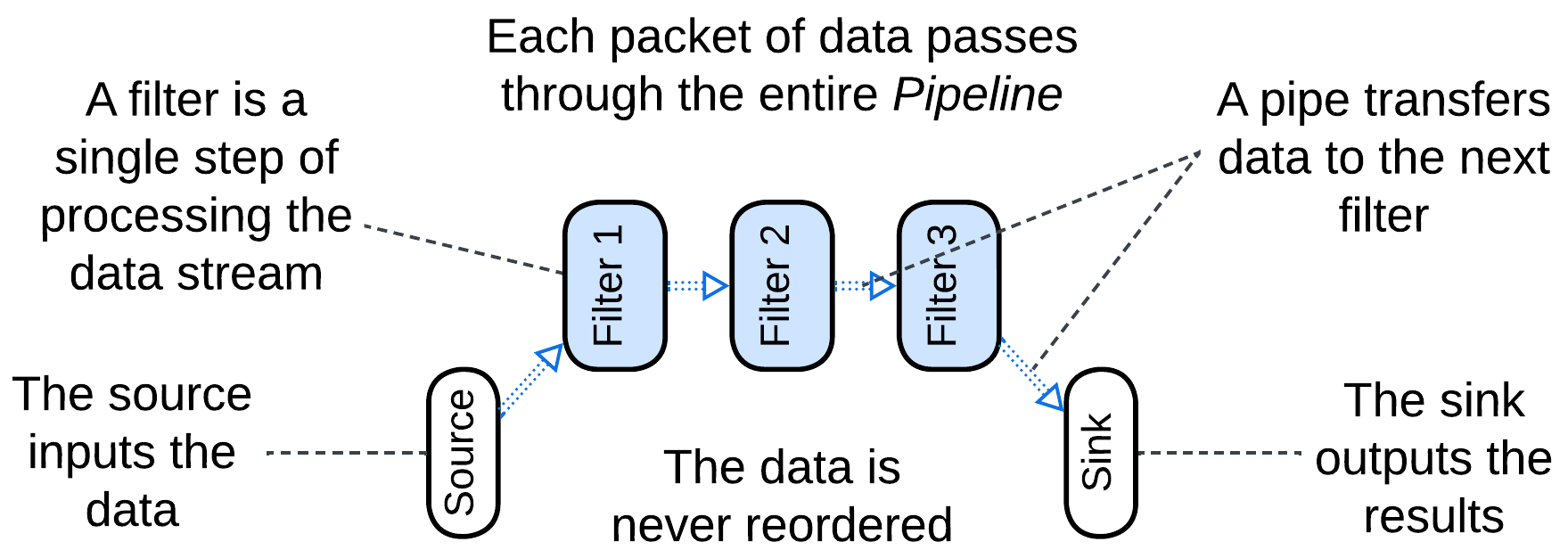
Pipes and Filters is about stepwise processing of a data stream. Each piece of data (a video frame, a line of text, or a database record) passes through the entire system.
This architecture is easy to build and it has a wide range of applications, from hardware to data analytics. Though each pipeline specializes in a single use case, it is often possible to build many different pipelines from the same set of generic components, which is actually practiced by Linux admins in their use of shell scripts [DDIA].
Choreographed Event-Driven Architecture#
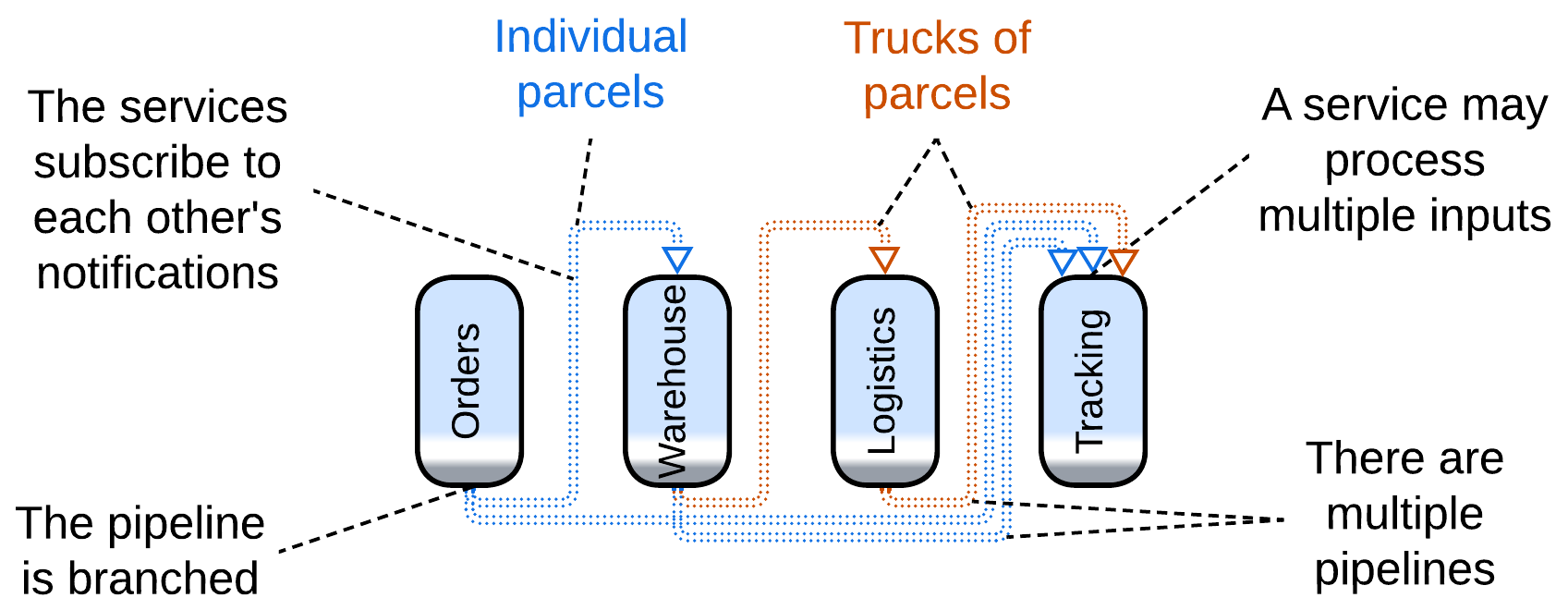
Relaxing the type and loosening the identity criteria opens the way to Choreographed Event-Driven Architecture, in which a service publishes notifications about everything it does which may be of interest to other services. In such a system:
- There are multiple kinds of events going in different directions, as if several branched pipelines were built over the same set of services.
- A service may aggregate multiple incoming events to publish a single, seemingly unrelated, event later, when a certain condition is met. For example, a warehouse delivery collects individual orders till it gets a truckload of them, or until the evening comes and no new orders are accepted.
This architecture covers way more complex use cases than Pipes and Filters, because multiple pipelines are present in the system and because processing an event is allowed to have loosely related consequences (as with the parcel and truck).
Command Query Responsibility Segregation (CQRS)#
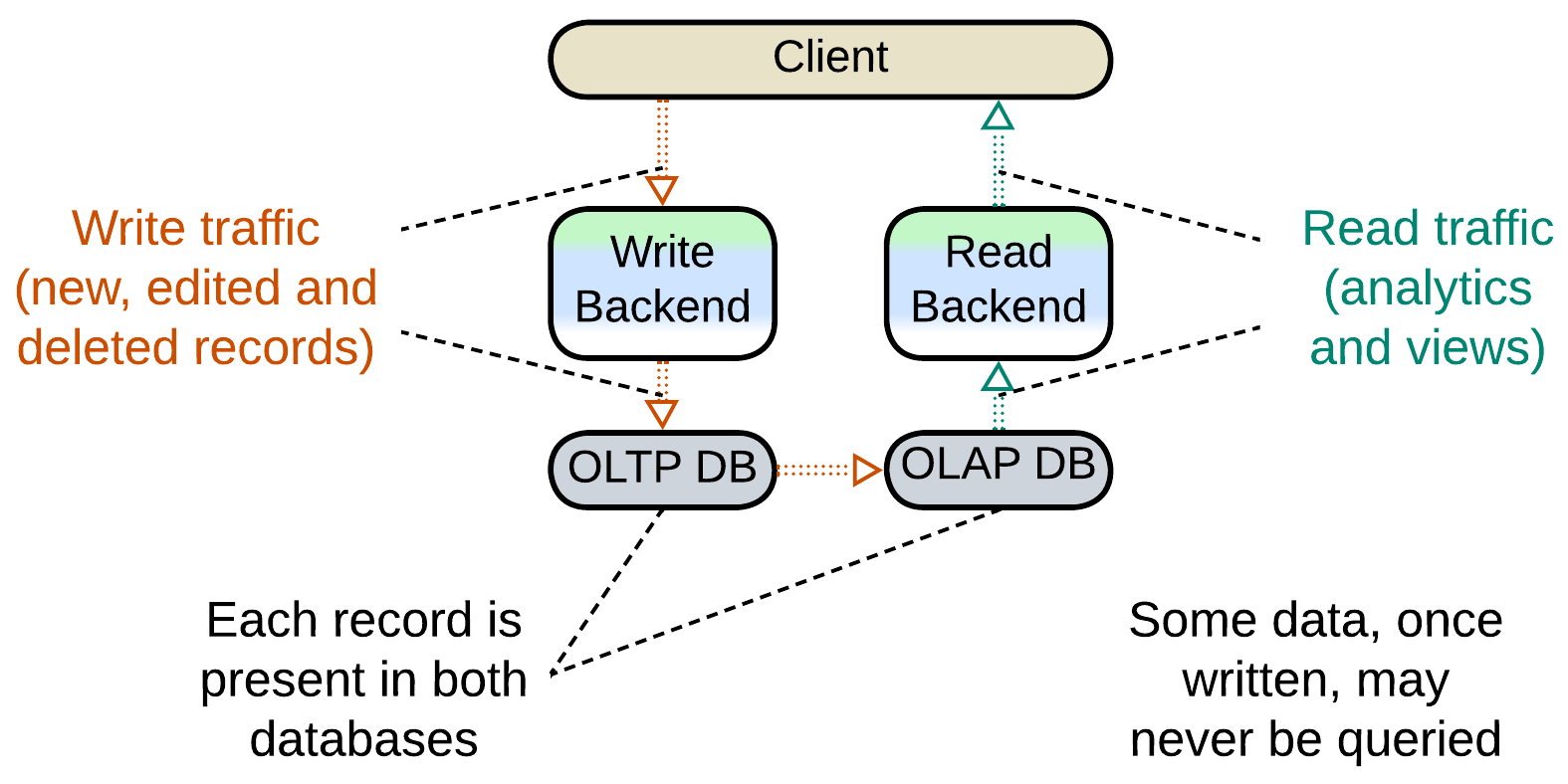
When data from events is stored for a future use (as with the aggregation above), both the type and the temporal order are ignored, but the data identity may be retained. A CQRS-based system separates the paths for write (command) and read (query) requests, making a kind of data processing pipeline with the database, which stores events for an indeterminate amount of time, in the middle. It is the database that reshuffles the order of events, as a record it stores may be queried at any time, maybe in a year from its addition – or never at all.
Model-View-Controller (MVC)#
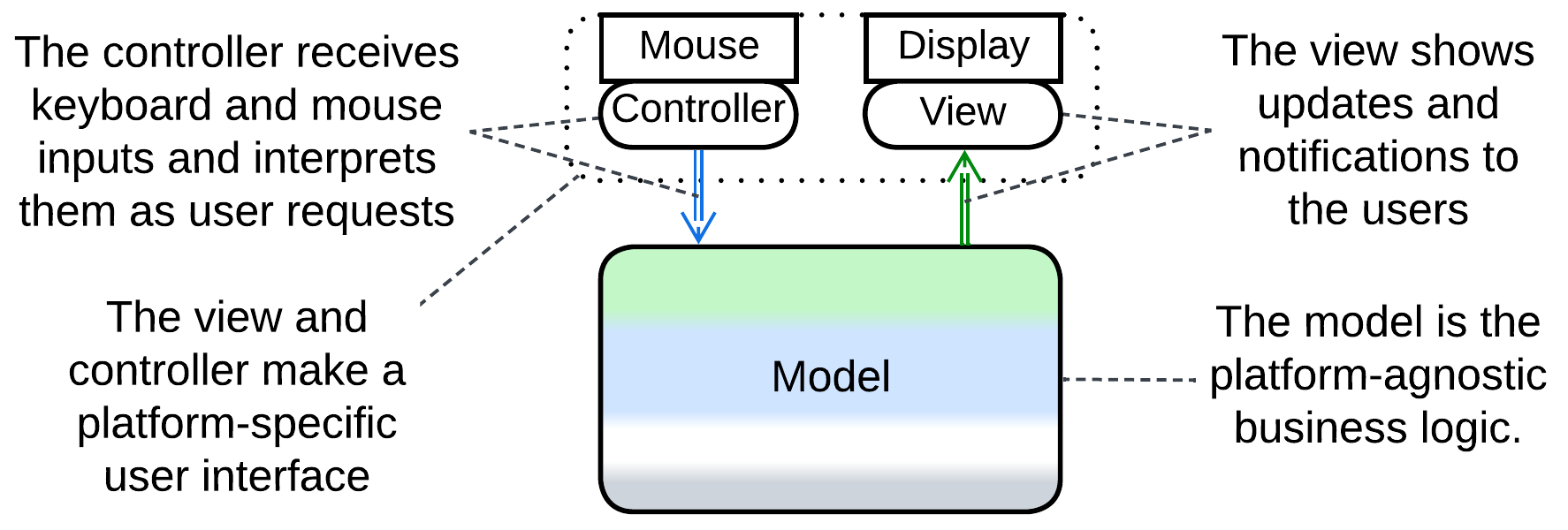
Model-View-Controller completely neglects the type and identity limitations. It is a coarse-grained pattern where the input source produces many kinds of events that go to the main module which does something and outputs another stream of events which have no obvious relation to the input. A mouse click does not necessarily result in a screen redraw, while a redraw may happen on timer without any user actions. In fact, this pattern conjoins two separate, short pipelines.
Summary#
There are four architectures with unidirectional data flow, which is characteristic of Pipelines:
- Pipes and Filters,
- Choreographed Event-Driven Architecture (EDA),
- Command (and) Query Responsibility Segregation (CQRS),
- Model-View-Controller (MVC).
The first two, being true Pipelines, are built around data processing and transformation, while for the others it is just an aspect of implementation – their separation of input and output yields pairs of streams.